- What Is Cognitive Health?
- The Key Domains of Cognitive Function
- Memory: More Than Just Remembering Names
- Executive Function: The Brain's CEO
- Attention and Processing Speed
- Language and Communication
- What Threatens Cognitive Health?
- Normal Aging vs. Significant Decline
- Building Your Cognitive Health Strategy
- The Role of Daily Nutritional Support
- Frequently Asked Questions
"Cognitive health" is a phrase that appears in wellness conversations with increasing frequency — but what does it actually mean? And why should someone in their 30s, 40s, or 50s be thinking about it now, rather than later?
This guide provides a clear, jargon-free introduction to cognitive health: the different mental functions it encompasses, what threatens them, how to distinguish normal aging from something worth discussing with a doctor, and — most importantly — the concrete, evidence-based steps you can take today to protect and support your brain's long-term health.
What Is Cognitive Health?
Cognitive health refers to the overall health and effective functioning of the brain's mental processes. It encompasses the full range of mental abilities that allow us to think, learn, remember, communicate, and engage effectively with the world around us. But it goes further than simply the absence of disease — cognitive health in its fullest sense describes a positive state: mental clarity, sharp thinking, emotional resilience, and the ability to learn and adapt throughout life.
The World Health Organization defines cognitive health as a component of mental health, embedded within the broader concept of overall brain health — the state of the brain that enables people to reach their potential over their life course. This framing is useful because it highlights that cognitive health is not a single trait but a dynamic state, influenced by our daily choices and environments in ways that accumulate over time.
The Key Domains of Cognitive Function
Cognitive function is not a single, monolithic ability. It comprises several interrelated domains, each supported by distinct neural networks:
- Memory — encoding, storing, and retrieving information
- Executive function — planning, decision-making, cognitive flexibility, inhibitory control
- Attention — sustained focus, selective attention, divided attention
- Processing speed — how quickly the brain takes in and responds to information
- Language — understanding and producing speech and written communication
- Visuospatial ability — perceiving and navigating spatial relationships
These domains interact and depend on each other. Good executive function supports effective memory encoding. Adequate processing speed underpins efficient language production. Disruption to one domain often has ripple effects across others.
Memory: More Than Just Remembering Names
Memory is often thought of as a single function, but it is actually a family of distinct systems, each with its own neural architecture:
- Working memory: The brain's mental scratchpad — temporarily holding and manipulating information needed for immediate tasks. Limited in capacity; affected by stress, sleep, and age.
- Episodic memory: Memory for personal experiences and events — "autobiographical" memory. Heavily dependent on the hippocampus.
- Semantic memory: Memory for facts and general knowledge — the meaning of words, historical events, conceptual information. More distributed throughout the cortex.
- Procedural memory: Memory for how to do things — riding a bike, playing an instrument, typing. Stored in different brain structures (basal ganglia, cerebellum) and remarkably durable even with significant hippocampal damage.
- Prospective memory: Memory for intended future actions — remembering to take medication, attend a meeting, call someone back. Often the first to show wear with age or distraction.
Understanding which type of memory is struggling can help identify both the causes and the most effective support strategies.
Executive Function: The Brain's CEO
Executive function is housed primarily in the prefrontal cortex — the most evolutionarily recent and, in some ways, most distinctly human part of the brain. It encompasses the higher-order cognitive abilities that allow us to plan, organize, adapt, and regulate our behavior in the service of longer-term goals.
Key components include:
- Working memory (also a component of executive function): temporarily holding information in mind while using it
- Cognitive flexibility: shifting attention between tasks or mental sets
- Inhibitory control: suppressing automatic responses in favor of more considered ones
- Planning and organization: breaking complex goals into actionable steps and managing their execution
Executive function is one of the domains most sensitive to lifestyle factors — particularly sleep, stress, and cardiovascular health — and is also one of the domains that most powerfully affects quality of life, productivity, and relationship quality.
Attention and Processing Speed
Attention is the gatekeeper of cognition — information that doesn't get attended to doesn't get encoded, processed, or remembered. Sustained attention (the ability to maintain focus over time), selective attention (focusing on relevant stimuli while filtering irrelevant ones), and divided attention (managing multiple streams of information simultaneously) all play distinct roles in everyday cognitive function.
Processing speed — how quickly the brain takes in, evaluates, and responds to information — tends to slow modestly with age, though the degree of slowing varies enormously based on lifestyle and individual factors. Slower processing doesn't mean less intelligence or less capability; it often means tasks simply take a little longer. But in fast-paced environments, processing speed can have real quality-of-life implications.
Language and Communication
Language abilities — understanding spoken and written communication, retrieving the right words, and producing coherent speech — depend on an extensive network of brain regions. The experience of "tip-of-the-tongue" — knowing a word exists but being temporarily unable to retrieve it — is a common age-related phenomenon that reflects changes in the speed and reliability of lexical retrieval rather than any fundamental deterioration in language knowledge.
More significant language difficulties — persistent word-finding problems, difficulty following conversations, or problems comprehending written text — warrant professional evaluation, as they can be early indicators of conditions that benefit from timely attention.
What Threatens Cognitive Health?
Research has identified a robust set of modifiable and non-modifiable risk factors for cognitive decline. The encouraging news is that the modifiable factors — which are within individual control — account for a significant proportion of dementia risk globally. Key threats include:
- Poor sleep quality and quantity — disrupts consolidation and allows metabolic waste accumulation
- Physical inactivity — impairs cerebral blood flow and BDNF production
- Poor diet quality — deprives the brain of essential nutrients while promoting inflammation
- Chronic stress — elevates cortisol, damaging hippocampal structure
- Social isolation — reduces cognitive stimulation and increases inflammation
- Cardiovascular risk factors — hypertension, diabetes, and high cholesterol all impair cerebral blood flow
- Hearing loss (untreated) — emerging evidence links untreated hearing loss to accelerated cognitive decline, possibly through increased cognitive load and social withdrawal
- Heavy alcohol use and smoking — both directly damage brain structure and function
- Depression and anxiety — associated with both cognitive symptoms and increased long-term dementia risk
Normal Aging vs. Significant Decline
One of the most anxiety-provoking questions for many people is: "Is what I'm experiencing normal aging — or something more?" While only a healthcare professional can provide a proper evaluation, some general distinctions help frame the question:
Generally normal aging: Occasionally forgetting names but remembering them later; taking slightly longer to learn new skills; needing more time to find the right word; sometimes misplacing objects; mild difficulty with multitasking.
Signs worth discussing with a doctor: Frequently forgetting important events or appointments; getting lost in familiar places; difficulty managing finances or following familiar recipes; repeating the same questions in a single conversation; significant changes in personality or behavior; difficulty following the plot of a book or television program.
If you have concerns, the appropriate next step is a conversation with your primary care provider. Early evaluation is always better than late — and anxiety about cognitive health itself can impair cognitive performance, so addressing concerns proactively has benefits in either direction.
Building Your Cognitive Health Strategy
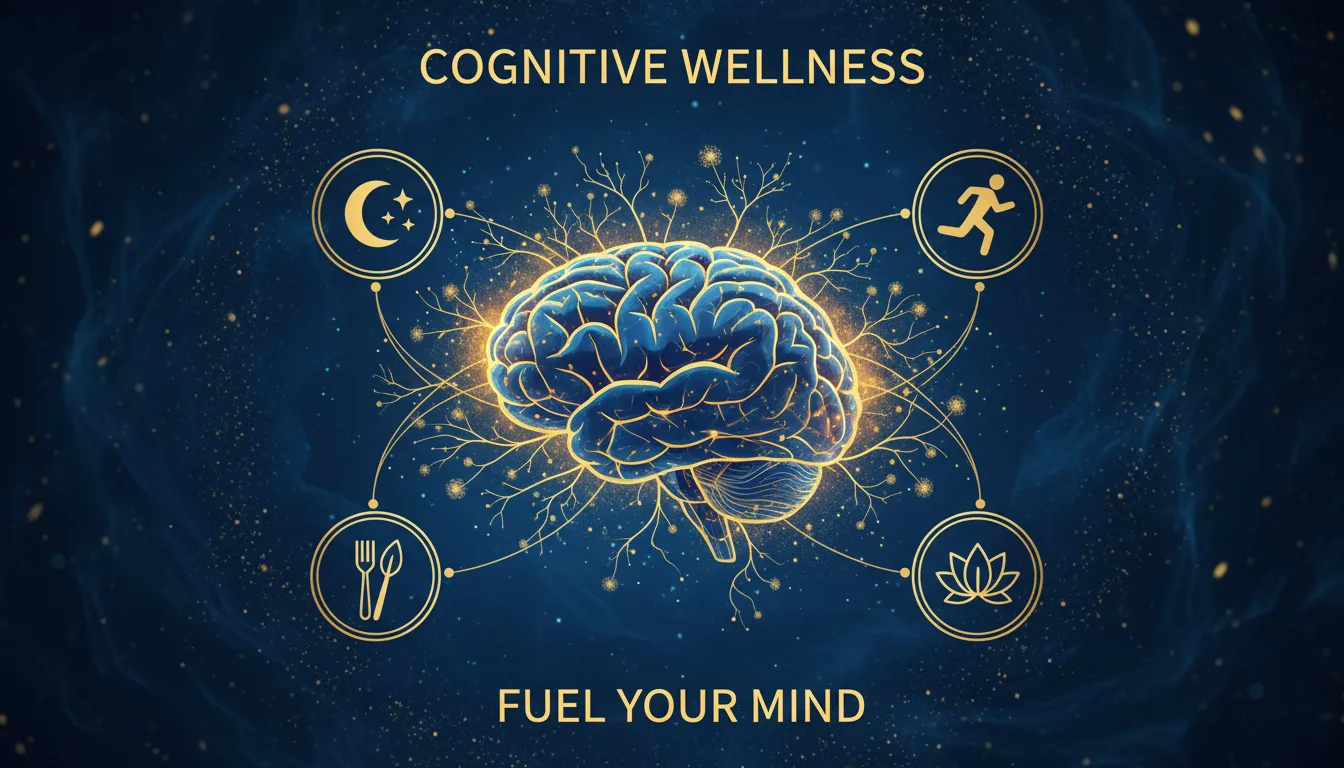
The most evidence-supported approach to protecting cognitive health is a multi-domain lifestyle strategy — addressing several areas simultaneously rather than relying on any single intervention:
- Sleep: 7–9 hours per night, with consistent timing
- Exercise: 150 minutes of moderate aerobic activity per week, plus resistance training
- Diet: Mediterranean or MIND dietary pattern — abundant plant foods, fatty fish, nuts, olive oil
- Mental engagement: Continuous learning of genuinely novel, challenging skills
- Social connection: Active maintenance of meaningful relationships
- Stress management: Regular mindfulness practice, exercise, and meaningful downtime
- Cardiovascular health: Manage blood pressure, blood glucose, and cholesterol through lifestyle and medical care as appropriate
The FINGER trial — a large randomized controlled trial conducted in Finland — demonstrated that a multi-domain lifestyle intervention significantly reduced cognitive decline over two years compared to control groups. The evidence strongly suggests that combinations of lifestyle interventions are more effective than any single one alone.
The Role of Daily Nutritional Support
Nutritional support forms a meaningful part of a comprehensive cognitive wellness strategy. Several natural ingredients have been studied in human clinical trials for their potential effects on memory, attention, and cognitive performance. These include Bacopa Monnieri, Lion's Mane Mushroom, Ginkgo Biloba, Phosphatidylserine, Huperzine A, Ashwagandha, and Vitamin B12.*
MemoHoney® was formulated to bring these researched ingredients together in a single convenient daily capsule — designed to complement the foundational lifestyle practices described throughout this guide. A brain-healthy life and daily nutritional support are not competing approaches — they are complementary parts of a comprehensive cognitive wellness strategy.*
*These statements have not been evaluated by the Food and Drug Administration. This product is not intended to diagnose, treat, cure, or prevent any disease. Consult your healthcare provider before starting any new supplement.
Support Your Cognitive Health With MemoHoney®
A comprehensive daily formula with 8 researched natural ingredients — designed for long-term memory, focus, and mental clarity support.*
Claim Your MemoHoney SupplyFrequently Asked Questions
You Might Also Like